Ninad Shinde- An Engineer’s Journey to The World of Investing
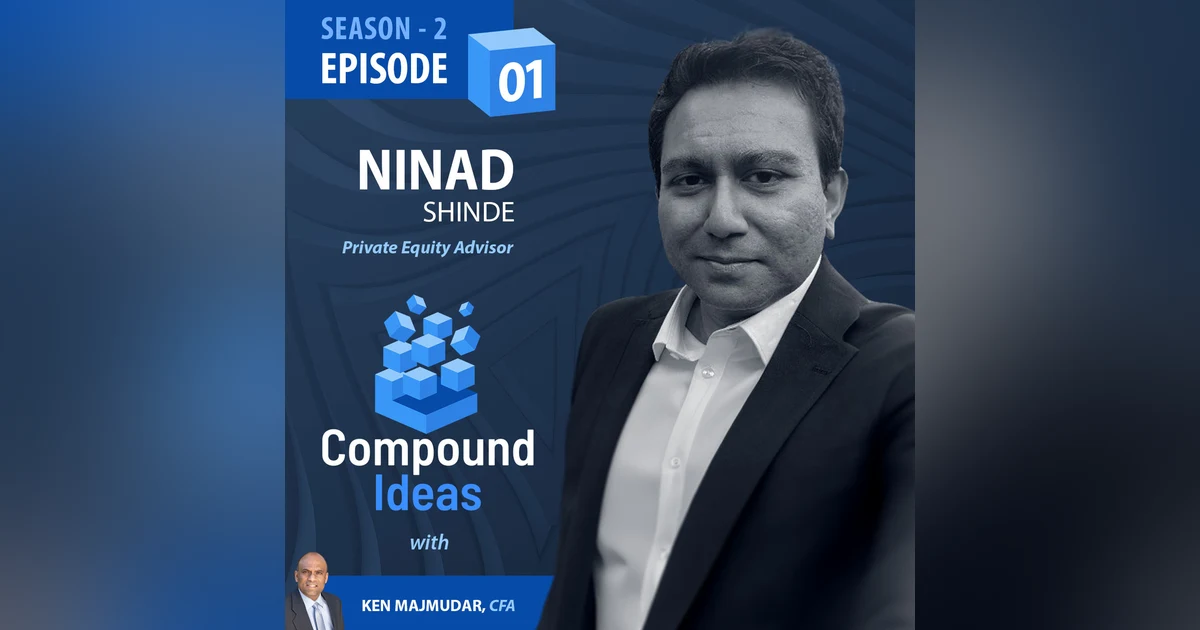


My guest today is Ninad Shinde, private equity advisor & vet care entrepreneur. Our discussion includes Ninad’s diverse background spanning growing up in India, attending business and engineering schools, living in the US, and spending the last decade in London. With a broad mind and interests in investing, technology, and luxury companies, he brings a wealth of knowledge to this wide-ranging conversation.
Please enjoy my conversation with Ninad Shinde.
------
For more episodes of Compound Ideas, visit Compoundideasshow.com
For more insights like these and to contribute to the conversation go to: https://www.ridgewoodinvestments.com/insights-from-our-founder
Follow Ken Majmudar on:
Linkedin @kenmajmudar
YouTube - Investing with Ken Majmudar
Instagram - @kenmajmudar
X/Twitter - @kmajmudar
Resources
https://www.linkedin.com/in/ninadshinde/
https://www.amazon.com/Zero-One-Notes-Startups-Future/dp/0804139296
https://www.berkshirehathaway.com/letters/letters.html
Show Notes
[00:02:12] - Ninad recalls his formative years in India, and how his cosmopolitan upbringing played a pivotal role in shaping his worldview and fostering an appreciation for diversity.
[00:03:06] - Ninad’s remarkable international career journey.
[00:04:58] - Ken and Ninad engage in a discussion about the evolving nature of India.
[00:06:54] - Contemplating the differences between the Indian and American education systems and the cultural differences in how elders are perceived and respected.
[00:09:07] - Recalling his Catholic school education in India, Ninad notes the impactful role of exams in shaping his future, emphasizing his passion for self-directed learning.
[00:11:50] - Ninad describes his academic journey at Purdue University, covering his transition from mechanical to electrical engineering.
[00:14:22] - Motivated by the challenges and intricacies of semiconductors in the dot-com boom, Ninad explains his shift into the interdisciplinary realm of microfluidics.
[00:16:38] - Drawing on his analytical engineering background, Ninad explores a transition to management consulting.
[00:23:17] - Ninad discusses the key elements in comprehending incentives and motivations within the realm of business decisions.
[00:25:52] - After consulting, Ninad pursued business school in London for a challenge shifting into investment banking during the financial crisis.
[00:28:04] - Becoming disillusioned with investment banking, Ninad discovered that it failed to provide the expected instruction on valuing companies.
[00:33:38] - Ninad reflects on his years of experience, sharing the essential insights gained.
[00:37:42] - Ninad shares his journey as an amateur investor, attributing early success to the guiding principles of Warren Buffet and Charlie Munger.
[00:44:52] - Ninad highlights the significance of adaptability in value investing, emphasizing his concentration on economically promising sectors with enduring growth potential.
[00:50:28] - Ken and Ninad discuss investing in hyperscalers, addressing growth concerns and lack of pure plays.
[00:57:41] - Ninad highlights luxury goods as a top investment theme, noting their universal appeal and sustained demand driven by intergenerational wealth transfer.
[01:07:25] - Ninad explores the lucrative investment prospects in veterinary care with his new project, Virtue Vets.
Narrator: [00:00:04] Welcome to Compound Ideas, hosted by Ken Majmudar of Ridgewood Investments, this podcast will feature exceptional individuals to uncover deep insights into business, entrepreneurship, personal growth, investing, and multidisciplinary thinking so that you can learn how to improve your finances, find better investments, and pursue authentic lifelong growth, wisdom and happiness. Learn more and stay up to date at compoundideashow.com.
Ken Majmudar: [00:00:35] Our conversation today features Ninad Shinde. I met Ninad in person at Valuex Middle East a few months back in Dubai. I enormously enjoyed talking to Ninad. He has a wonderful background that cuts across a number of different experiences, from growing up in India to attending business school and engineering school, spending a good part of his life in the US, to now having spent the last 10 to 15 years in London in the UK. Ninad has a very broad mind and a broad range of interests, including investing. Exposure to technology and semiconductors, also a great deal of knowledge in luxury type companies.
Ken Majmudar: [00:01:16] This episode of Compound Ideas was recorded just prior to the death of Charlie Munger at age 99 this past November, just shy of his 100th birthday. As you'll hear in this episode, Charlie Munger has been a tremendous influence to investors such as Ninad and myself, and we all owe Charlie an incredible debt of gratitude for the wisdom and the lessons that he has shared freely with so many people, including ourselves, that we have benefited from so generously. Charlie Munger, rest in peace,
Ken Majmudar: [00:01:54] Ninad. Thank you for coming on to the show. It's a pleasure to have you.
Ninad Shinde: [00:01:58] Thanks for having me.
Ken Majmudar: [00:01:59] So where we usually start is origin story. Just so we can understand a little bit about your background and where you're coming from. So tell us where you grew up and what your formative experiences were growing up.
Ninad Shinde: [00:02:12] Everything about me has a bit of a portfolio approach to it in my life, a bit of a portfolio or two about where I came from and where I am today. So from a personal life perspective, but also from a career professional experience. I was born in India, in Mumbai, which is, as you know, big metropolitan city. I spent a third of my life over there, and I think those were kind of formative years. But the thing about India back then, which I can say distinctly is different from the India of today, is that it was actually quite a secular and open place. And I really enjoyed growing up in that atmosphere where sort of, you know, you were surrounded by people from so many different religions and different parts of the world too, in fact, living in India. And then sort of that was a part of my formative experiences living a cosmopolitan upbringing in an Indian environment. I left and came to business school in the US. I spent a third of my life there. I went to university at an engineering school, got a masters in engineering. I'm a semiconductor engineer by training, and then after that I work for a consulting firm based out of Boston and most of my life, turning around businesses, fixing them, making them better than what they were when working with private equity firms, essentially. So PE firms buy a business. It's not in such a great shape. You go in there and help them optimize the business and then sort of fix it and flip it in sort of 3 to 5 years.
Ninad Shinde: [00:03:40] That's kind of the game. So did that for a fair amount of time living in Boston, after which I moved to the UK to go to business school at London Business School. I thought it was going to be a couple of years in living in London and then back to the US. But, you know, almost a 15 years on, I'm still here in the UK, so spent a third of my life in the UK now. Did a variety of things professionally since business school, including investment banking, work in leveraged finance, sponsors banking. After that went back to what I do very well, which is advising private equity guys when they're buying companies on how to think about adding value to those businesses. How do you take those businesses, upgrade their performance and increase, as you know, EBITDA by significant amount? We're talking about a, you know, even a 30 to 40% improvement in EBITDA over a 12 year period, 12 month period is a significant improvement for them. Game for them is selling those businesses in 3 to 4 years after they acquire it. So when you've created that kind of EBITDA improvement and you put that on a ten times multiple, that's a lot of money from an equity perspective for PE clients. So that was kind of most of what I've done.
Ken Majmudar: [00:04:58] Let me double click on a couple of things going all the way back. So you mentioned India used to be cosmopolitan. I'm from India, but I came to America when I was five. So I don't have the experience of growing up in India. I guess implied in that observation is that maybe things have changed. Can you give a sense of what might be your experience versus maybe today's experience?
Ninad Shinde: [00:05:18] Yeah, there's a lot of things that you can say about the country today without necessarily being political. I mean, I think there's been a tremendous change in the political climate in the country over the past, sort of 30, 40 years. I think what I remember about India back then was it was a freer country when it came to the beliefs that that you could espouse or adhere to. I mean, even from a religious perspective, I think there was more religious freedom back then. There was sort of more freedom to say what was on your mind. And I think those are the things fundamentally, I think have changed since over the past 40 years. There have been things that have improved economically. I mean, and it's fair to say that the country has done better over a period of time economically, but from the perspective of journalistic freedoms, that has not fared so well over the past couple of decades. And as an Indian, I think we were raised to embrace plurality of thought, plurality of religion and points of view. And I think it would be a fair criticism if someone said to me, well, you haven't lived in the country for 30 years, so how could you say that? But looking outside in, I feel the plurality has declined over a period of time. That, to me was the essence of what India was back then. And in addition to the fact that it's a very vibrant culture and some pretty amazing people.
Ken Majmudar: [00:06:43] Absolutely. And then as far as your education in India, what was that like? What led you to then go to, I guess, college in the United States for a semiconductor engineering?
Ninad Shinde: [00:06:54] I think the education system was tough compared to when I arrived in the US. I found the US system to be a bit more relaxed when it came to sort of the rigor associated with it, but if I were to contrast the US and the American and the Indian system, I think the Indian system is more rigorous, but it's more focused on rote learning as opposed to I think the American education system as a whole is based in the fundamentals of the liberal arts. It's got a more liberal arts take to it, where you think for yourself, you learn to ask questions, you learn from experimentation and so on and so forth. And sort of, that wasn't what the Indian system was about. But on the other hand, the Indian system had a very strong focus on S.T.E.M. like STEM topics. I mean, science, technology, engineering, mathematics. And if I would extend that further to things like medicine and so on and so forth. So that's something I think was drilled into us at a very early age. We could use more of that in the Western world, frankly, because you're going to need that, especially with AI and so on and so forth.
Ninad Shinde: [00:07:59] Uh, coming to the fore, our generation, the next two generations coming after us, it's important to have these skill sets. And I think that's something that India and some other countries did pretty well. One last thing I'll say about that is valuing education. And I think I risk stereotyping myself as one of those tiger parented people. But I think it's important to value education. And one of the things that India does well is teaches people to respect elders. I mean, not to necessarily revere, revere them, but, you know, you need to respect people who've had the experience and who've, who've seen the world and who've seen more things. And, you know, in the light of obviously, you can contrast that with the okay boomer meme and say, well, you know, well, perhaps in the West, you know, we don't really value our elders as much. And as a consequence of that, maybe we don't take as good care of them as we should, but that's a whole different topic to talk about. But philosophically, those are the differences between the two.
Ken Majmudar: [00:09:00] Just to get it on, like your experience. So where was high school and where was college. And contrast those two experiences. Uh, briefly.
Ninad Shinde: [00:09:07] Yeah. So I went to a convent school. So a Catholic school in India. So I think when you look at the education system in a lot of the better schools, for the ones that were either started by the British before they left the country, or some of the better schools were schools that were run by Catholic parishes, essentially. So I went to a school called Saint Joseph's and it was an English medium school. English was the first language I spoke that I was taught at home, and my entire education at that school was in English by teachers who were, some of whom were Indians, some of whom were Americans, some were, some were Dutch, some were British. So it was a pretty broad variety of international people who came to India to teach. I thought it was very holistic education in terms of sort of high school. And then what we call junior college in India, which is sort of two years of almost sort of prep before going to university, that was actually quite rigorous because there was no time for fun and games. My parents would have none of anything other than an A plus. So I became a bit of a nerd, frankly, thanks to that experience.
Ken Majmudar: [00:10:17] Join the club.
Ninad Shinde: [00:10:19] What I could say is that when I was in these, in high school and I was in, uh, what we call junior college in India, the difference was that because there was so much, such a huge focus on succeeding in that one exam, that determines the entirety of your future. How well you do in that exam kind of determines which universities you go to.
Ken Majmudar: [00:10:40] One of them is called O-levels and one of them is called A-levels. Is that correct?
Ninad Shinde: [00:10:44] It's the equivalent of that. There's a variety of systems in India, but it's the equivalent of that. India is notorious for having a series of these one exams that determines the rest of your life. I wasn't smart enough to get into what's called the Indian Institutes of Technology, which is one of the toughest exams in the world to crack. The acceptance rate into the Indian Institute of Technology is way lower than even Harvard for that matter. It's one of the toughest exams to crack. But I mean, because you're so laser focused on cracking those exams, you miss out on a lot of things in life. Frankly, I had a lot of catching up to do once I came out of that system. And when I started learning about the world, I mean, I had to teach myself history. I had to teach myself a variety of topics. This is a good thing that I'm an autodidact. I mean, I love learning, so I had to teach myself how to learn those things and which are the influences that I really want in my life, and so on and so forth.
Ken Majmudar: [00:11:45] Where did you go to college then, and what made you think, oh, I'm going to go abroad to this college.
Ninad Shinde: [00:11:50] I went to Purdue University, which is one of the top, I'd say, ten engineering schools. I started off studying in mechanical engineering and then over time migrated slowly over to the world of electrical engineering and semiconductors. And what I was trying to do was build what's known as microelectromechanical systems. So these are extremely small devices, microscopic in nature, which can fulfill a variety of functions. And they are manufactured by the same techniques that we use to make semiconductor devices. So a good example of those would be the accelerometer that is in the, inside a car, inside the steering wheel of a car that detects if there is a crash. That is made, actually microscopic piece of silicon with some semiconductors built around that particular device to detect if there has been a collision and if the airbags should deploy.
Ken Majmudar: [00:12:53] Those are also in iPhones, I think.
Ninad Shinde: [00:12:56] Exactly. Those are gyroscopes and things of that nature which are in iPhones. And there is another application for these devices which are, they're known as microfluidic devices, which are used for analyzing drug samples or biochemical samples. So, so that's sort of how I switched to semiconductors, actually. I helped develop a device which is used for accelerating the speed at which you can develop and test new drugs. It's a field known as microfluidics. The thing that people would have seen the most is the drug, the assays that we use for Covid, the ones in which you squeeze a drop of liquid and it tells you whether you've got, uh, it's called a lab on a chip device. And it's a very simple device, the one that we've used through throughout the pandemic.
Ken Majmudar: [00:13:47] You contributed to that at undergrad or?
Ninad Shinde: [00:13:50] That was in graduate school.
Ken Majmudar: [00:13:52] What was it a shock to go to like Purdue? I think it's in Indiana, right. Compared to Mumbai?
Ninad Shinde: [00:13:57] Yeah, absolutely. It was certainly it was a different lifestyle. The further you went away from the student union, the more out of pocket. It felt very strange. And, you know, people looked at you a bit strangely, I have to say.
Ken Majmudar: [00:14:13] And why did you decide to go into semiconductors? Was there some insight or something that interested you? And around what year would this have been?
Ninad Shinde: [00:14:22] This was pre 2000, I mean actually 2000 to be very precise. So obviously this was the.com boom and sort of everything was about the internet and what was the internet is semiconductors. So I started studying semiconductors. I also wanted a bit of a challenge because I'd spent most of my life before that doing mechanical engineering, which is relatively simple compared to semi, which is, uh, extremely complicated. And it's quite challenging when you think about pushing the boundaries of physics, essentially, and there's a lot of math involved. There's a lot of physics involved when you're thinking about atoms and molecules of that scale. So it all comes together with one, it's a challenging field but on the other hand, it's also the future of sort of where we're headed. So that was what I was interested in. And then I found this area, as I said, this microfluidics area, which is a combination of not just semiconductors, but also sort of helping develop techniques that could improve how drugs are discovered and so on and so forth. So I worked for a while for, I quit my PhD, actually, I was doing research at Cornell while I was studying at Purdue, and I met a group of people who had started this company. Which, based on a Nobel Prize winning technology that came out of actually out of Cornell, called electrospray ionization, which it sprays tiny samples into an analysis device called a mass spectrometer. The spraying of these samples is done using one of these microscopic devices, about six microns in radius, or 12 microns in diameter. So about a fifth of the width of a human hair, essentially is what we're talking about. So you can't really see them, but they can massively parallelize the process of drug discovery. So I helped develop and build some of these devices. And eventually the startup that I was part of was acquired by a much larger contract research organization called Quintiles in the US. That sort of was my segue from the semiconductor into sort of wanting to do something that could have an impact, young and foolish. I wanted to have an impact on the world.
Ken Majmudar: [00:16:30] I see. So let's fast forward to, I guess somehow you got into business stuff. When was that and what was that experience like?
Ninad Shinde: [00:16:38] Yeah, I mean, I think the business transition was because I realized that as an engineer, as a researcher, as a product developer, I mean, you do certain things, but essentially what really matters is how do you commercialize those and how do you raise the financing to do what you're trying to do. I realized that I needed a broader skill set than the one that I had. If I wanted to do things of that nature, if I wanted to bring an idea to life like most other people. I decided to switch to management consulting, which is why I moved to Boston. I lived in Ithaca, New York for about three winters, which was one winter too much, frankly. Well, you know, snow in June. So.
Ken Majmudar: [00:17:17] So how did you get the management consulting job from a technical background? Was it easy? Was it difficult?
Ninad Shinde: [00:17:22] It was actually not too hard. It was it was all about it was case studies essentially. So, you know, how do you take a problem and break it up into its elements? And coming from an engineering background, which is tends to be highly analytical, that whole process of taking a problem and structuring it in a way, using either a decision tree or a problem solving tree that is pretty much most of engineering is you say, okay, here is a variable that I want to control. How do I control that variable using these 7 or 8 other variables. So we are used to taking things and putting them into equations, and then figuring out how the different parts of that equation interact with each other and interact with the external world. So really when you think about business and you know, once again, when people say business, there's no right answer in business. I mean, that's true, but at least you need to know what are the different variables that control different things. And, you know, a lot of management consulting when you think about the world as being 80/20, sort of you're trying to get the biggest bang for the buck. That is also very much aligned with physics envy management consulting. Just like economics has physics envy, they like to take something and try to make an equation or a framework or a formula out of it. It does lend itself to people who come from that perspective, from a science, technology, engineering perspective. So making that switch wasn't actually that hard. Finding the job wasn't initially that hard, and the kind of consulting that I went into which I did not know, it was a happy accident, frankly, was less about the death by PowerPoint and more about getting things done. So the firm that I work for, which is based in Boston.
Ken Majmudar: [00:19:09] Which one was it? Just so.
Ninad Shinde: [00:19:11] It's a tiny boutique called Stroud Consulting.
Ken Majmudar: [00:19:14] Stroud. Okay. But all these boutiques usually spin out of somewhere.
Ninad Shinde: [00:19:18] Yeah, I think they were partially McKinsey and partially one other operational consulting firm, if I'm not mistaken. But the focus was primarily on how do you make an impact within a short period of time. And the impact is not creating a 200 page deck, and that nobody then reads off of that and helping some senior management with their agenda.
Ken Majmudar: [00:19:40] Did they have a specific focus on helping private equity firms with their problem companies?
Ninad Shinde: [00:19:46] Yeah, pretty much so we started off with working initially in consumer goods companies and helping optimize their operations. But over time we largely work with PE firms. So I mean, an example of that would be if a private equity firm wanted to carve out a portion of packaging company with ten sites across North America, and the goal of carving out those ten sites was to optimize 7 or 8 of them and then shut 2 or 3 so that you basically restructure the footprint to some extent. But at the same time, you're improving the effectiveness of each of the manufacturing sites so that they can make maybe twice as much with the essentially the same inputs. So basically you're increasing the efficiency of those factories significantly. That was a lot of what we did was helping PE guys buy a company, helping them roll up more companies, acquiring more companies that were similar. So essentially they could bolt on to that platform. Other paper packaging businesses, factories and turn it into a 20 site company that is a lot more efficient. So essentially they were tripling or quadrupling what they had put into the original business. And so essentially we're talking about a 4x return on their investment within maybe like a two and a half, three year period. And those are the good old days in America where you could do this. I mean, there's a lot of opportunity of this sort. This still is. You just have to go further scale and sort of that's a lot of what's going on right now in the market is sort of consolidation place and so on and so forth. But there's various ways.
Ken Majmudar: [00:21:21] You did a consulting for pretty much a long time, right?
Ninad Shinde: [00:21:24] Yeah. So that was my first foray into consulting. I mean, even though it was quote unquote consulting, it was more sort of gun for hire. So it was a very, very hands on role in which we would get parachuted into a business. And it was a scary place to be as a 25 year old where you sort of, you know, parachuted into a business alongside people who've been in that company all their lives, they're in their 50s and 60s, and you're going in there and saying, hey, we need to improve how we do things and so on and so forth. And essentially, you're telling them everything that they've done in their lives over the past 30 years has been wrong, and we need to change things around and shake things up. So I think obviously from a technical perspective, it's not that hard to do these things from a technical perspective. It's a problem solving game. You can get to the answer very quickly, but it's all about influencing people essentially. What is the additional thing that I learned through my experience in management consulting? I would say that would be this concept of influencing people, especially in the types of roles that we were in, where we were there to make sure that change actually happened. So the average McKinsey, for example, will go into a business and they will say, we suggest or recommend you do such and such thing, but they are not responsible for creating that change or effecting that change. They're not responsible for creating the burning platform, for the management team to actually take those recommendations and convert them into actions, which create that 40% increase over a 12 month period, which is, what is hard to do. So learning how to influence people who are twice your age and people who see you as a threat to them. Changing that perception to how I'm here to help you and I'm here to make you look good, I think was probably the toughest thing that I had to learn.
Ken Majmudar: [00:23:13] Give us the top 2 or 3 things on how you do that.
Ninad Shinde: [00:23:17] Charlie Munger says you need to understand what their incentives are and what their motivations are. So obviously, incentives are set by whoever is running the business or whoever owns the business. It is your job to feed back as an as a third party, in this case, to them to say this is what the incentive structure should look like for this management team. But I think there's a lot that is unsaid in terms of people's motivations. Obviously, in a capitalistic society, there is the motivation to make more money. So that can be fixed with incentives. But also there is pride. There is them looking good in front of their bosses, in front of their peers, in front of their families. There's a lot of these unsaid things, and everyone's got something that they want to accomplish and leave as a mark in their lives, and it's trying to understand what those things are very quickly and equally just trying to be personable. I mean, one of the things, I've been to pretty much every state in the US over the time that I lived there, because I was working with all these companies, with operations pretty much all across the country. So everywhere except Alaska, I've been in the US. And it's finding something that's common between you and the mine site manager at a coal mine in Wyoming, in the middle of Wyoming. You might think there's nothing common between us, but you need to find that very, very quickly.
Ninad Shinde: [00:24:41] And I think the more you do it, the more you put yourself in situations where you don't have any other option, other than to find something very quickly. There's something in common very quickly then the more successful you can be in these kind of roles. These are some of the people, even 20, 30 years later, we keep in touch. I mean, they follow my career, I follow their careers, and these are honest, hard working people that you need to just tap into. In this case, with this mine site guy, he liked horses and he liked to ride his Harleys. So he basically invited, instead of me flying in and out into Wyoming every week from Boston, he said, why don't you spend the weekend at my ranch and with my family and stay over and get to know me, go ride Harleys and I'll teach you to ride a horse and so on and so forth. And it was literally Harold and Kumar go to Wyoming. It was literally that sort of experience. I was the only brown person in town riding a Harley with him. I learned to ride motorcycles early on in life, going on a weekend ride very poorly. I don't know how to ride horses, but he tried his best to teach me. Let's put it that way. I think it's about being personable. Just being human with these people who are trying their best essentially.
Ken Majmudar: [00:25:52] Makes sense. So let's fast forward to you do all this consulting. And then I guess your next thing was business school. And then what you did after.
Ninad Shinde: [00:26:00] Business school was primarily because I needed a challenge. I needed something different. At that point, I had done a lot of this type of consulting, as you said, where it had become not easy, but it was quite repetitive. I'd spent a third of my life in the US, and I wanted to sort of experience something different from that, so I tried to do all of that by going to business school in London, which was a good place to go and have an international education, meet a lot of people. And London Business School sort of prides itself as having a very international student population. Pretty much everyone is international. It's about 90% international. So the student population was quite diverse, and it's also one of the top universities for finance, along with sort of Columbia, Wharton, etc. and Penn. Columbia, Wharton and NYU being sort of the ones that we know of. That was the motivation to come to the UK. I did a bit of a career change from consulting to investment banking at that time in the mouth of the financial crisis, had the bright idea to join an investment bank, which was known as Lehman Brothers back in the day.
Ken Majmudar: [00:27:10] Yeah, I actually worked in the Lehman Brothers. But in the 90s, early 90s.
Ninad Shinde: [00:27:15] The good old days of Lehman, I joined the leveraged finance team at Lehman. I had an offer from them, and then the next day I had an offer from a Japanese bank which had acquired Lehman for the bust. So I ended up joining a Japanese bank called Nomura, which had acquired the Lehman operations in Europe and Asia. So I worked in leveraged finance for a while and then sponsors banking after that across a variety of private equity clients, helping them do deals, working with these PE guys and their management teams to try and fix companies and so on and so forth. And this is where does the leverage come from to help them, do M&A, help them do buy and build and so on and so forth. So they were always sort of M&A that they would do after they bought a business and bolt on.
Ken Majmudar: [00:28:01] So what did you do next after this?
Ninad Shinde: [00:28:04] I did that for a while and became a bit disenchanted with investment banking. I thought I would learn how to value companies. And turns out investment banks don't really teach you how to value companies, except for coming up with a football field. I sort of missed working with management teams and a hands on role and sort of helping create that value, and there were very few companies which did that going back sort of 10 or 15 years ago, which could offer the same career path that you could get within investment banking. But there are alternate ways in which you can work in an advisory role with clients and have the same kind of share of profit, if you want to call it that. So I started working for one of the 2 or 3 firms that are known for doing this. The first one I worked for was AlixPartners, and then I moved across to Alvarez and Marsal.
Ken Majmudar: [00:28:59] For those that don't know, those two firms that Ninad mentioned are two of the biggest turnaround restructuring advisers that I know of.
Ninad Shinde: [00:29:08] Both American firms. Both of them had started off, I'd say, about 30, 40 years ago when there were a lot of sort of bankruptcy cases and they would step into the business and optimize the balance sheet, but then also sort of do turnarounds. They're known for, ironically, in the case of A&M, they were the ones who unwound the Lehman assets, essentially, and did the restructuring of Lehman Brothers over a sort of 3 to 5 year period. Alixpartners is probably most well known for having done General Motors. They were acting as management at General Motors for a significant amount of time after the GFC.
Ken Majmudar: [00:29:46] Those are good businesses though, wouldn't you say?
Ninad Shinde: [00:29:48] Yeah, they're very good businesses. What they've done well over time is to be procyclical and anti-cyclical also, or rather countercyclical. So they do well when the world is doing well. Essentially what they realized was that the skill sets that they had, both from balance sheet and also from turnaround perspective, they were very much applicable to even healthy companies, especially in situations where the owners are ambitious, i.e. private equity firms or activist funds or so on and so forth, where if you want to accomplish a lot in a short period of time, you have to do things differently. You have to be pretty fast. The pace at which you do things, you reach decisions quickly. You make things happen. Then you bring along 200 people and get them to do one thing within a corporate environment, sort of a non private equity environment that takes a long time to get this ball rolling. I'm not saying necessarily every company, but by and large that's how it works. So they realize that that whole turnaround restructuring methodology was relevant in the context of private equity. So they started offering those services to PE firms. And there was a huge uptake for that.
Ken Majmudar: [00:30:59] I think that used to work more for the bankruptcy trustees at one point, and then the PE firms started hiring them before the trustee would take over the estate.
Ninad Shinde: [00:31:07] Yeah. So initially they started working with PE firms, which were about to lose their assets to creditors. So I've done some of those where you get parachuted in before like three months before they're about to breach covenants and they're saying basically they're like, well, we help us not breach covenants. And then it is a mad scramble. So there's huge chaos in the business. In some cases, we were able to at least the ones that I've worked on, buy them a year or two years in the business. You're working as management essentially, and you buy them a year or two, and in some cases they're able to turn the business around. In other cases, unfortunately, it does pass to creditors because we came in too late. They started off doing that. But I think that skill set and methodology and all of the stuff that you would do if you bring that to bear as soon as you acquire a business.
Ken Majmudar: [00:32:03] Don't wait till things go south.
Ninad Shinde: [00:32:05] Exactly. So they started doing that. They would buy beat up companies, but then we'd go in on day one. So even before they bought the company, they would come to us and say, well, how should we think about this business? What could we do with this company? What could this business look like if we did a full on turnaround over a three year period? So, I mean, we're talking about the likes of Apollo as an example. They're very good at this kind of work. Right. So you help them think through that and then you get parachuted into the business within three months after they've closed the deal, and then you're working with the management team to come up with a transformation program, and then you help them sort of execute the program, and then you're out of there in sort of 12 to 18 months because the business.
Ken Majmudar: [00:32:48] So just to calibrate now, this would be after business school. For how long did you do the restructuring work at Alix then?
Ninad Shinde: [00:32:53] Almost a dozen years. So the past dozen years is where this is kind of what I was doing after business school and after investment banking was helping PE guys think through what are they going to do when they buy a company? And then once they bought the business, I'd get parachuted in with a team of people sort of working for me in various circumstances and involved everything from pricing to M&A to improving the cost base essentially to over time, its PE firms started doing more technology transformation within businesses because it's no longer just tin can factory. The data is the factory, essentially. So you do need the data to help you make those decisions.
Ken Majmudar: [00:33:38] So at a high level, if you want to summarize, if you can, 10 or 12 years of experience in one or 2 or 3 key points for an amateur, what would you say your big learnings or takeaways are?
Ninad Shinde: [00:33:51] There is always opportunity to improve, and it sounds like a truism when someone says to me, can you improve something? I say yes, and if they say how much can you improve it by? My off the shelf answer is 30%. Can you make something 30% faster? Yes. Can you make something 30% cheaper? Yes. Can you improve sales by 30%? The answer is yes. So I think 30% is a good rule of thumb to have. I would say the second thing I've learned that that you need to be very adept at judging people, by which I don't mean being judgmental, but sussing out people and sort of figuring out when I say good, I mean competent or not. Is it competence? Is it malice? Is it someone's agenda? Or is it something else that is holding up someone could be a personal issue that's interfering. When we work with companies of this nature, that is something that we're asked a lot about the management teams. Is this management team good enough? Is the level 2 or 3 levels below the management team good enough? Usually that tends to be the bottleneck in any company. It's not about, and we're talking about over here, we're not talking about the Apples or the Nvidia's of the world. We're talking about bread and butter. Crank the crank. And it makes businesses even within technology or financial services. And I think the answer in those businesses, as with I think even with the Nvidia's of the world, is it always comes down to people. If you solve all the problems and you know what the solutions to the problems are and you're not able to fix the problem, the problem is almost 100% the person or a group of people. And we've seen this several times.
Ken Majmudar: [00:35:39] How do you fix that problem if it's a people problem?
Ninad Shinde: [00:35:42] Well, the people who own the business have to fix that problem. It's not something you can fix yourself. You can do what I alluded to earlier in terms of influencing people to a certain point, but it just lets you probe and figure out who's malleable and who will come along for the ride versus who's going to actively get in the way of the process. And then I think the trick over there, especially in the role that I was in, was to help the owners of the business, i.e., the private equity firms probe to figure out, to come to the same conclusion, which is a very tricky thing to do, because a very political thing to do, I mean, they have bet the farm on the management team by often bringing these people in from other senior roles elsewhere. So for them to fire an executive from one of these firms is a big deal. So you need to help them reach the conclusion themselves in a bit of a Socratic way, without being patronizing. People, uh people is the biggest thing. Third thing would be probably, I would say people are people everywhere.
Ninad Shinde: [00:36:46] For example, I mean, when people think about private equity firms, they think about it as this is Blackstone and so on and so forth. These people were my clients, are my clients and people are people. They need help. So if you think of, when I think of my clients at any of these big private equity firms, I don't think of them as people I should hold in awe in some shape or form, or people who are tough to deal with or so on and so forth. I think of them as people who are looking for help to accomplish the goals that they want to accomplish. And I think that's probably true about most areas in life that we think about people as people. And if you think about ways in which you can actually add value to them before they ask you to, then they will have all the time to talk to you, essentially. So they value because you're bringing ideas to them that they, they wouldn't have had themselves.
Ken Majmudar: [00:37:42] Very good insights. So now I want to switch a little bit because we met in the context of investing. Obviously it's taken us a while to kind of get there, but I think what you shared had a lot of value in a lot of different ways and insights and your life experience. We met at a Valuex Middle East. I've also been to the Valuex in Klosters. I was there at the first one. Let's talk about your arc in the world of investing. I guess you haven't managed other people's money, correct? Only your own.
Ninad Shinde: [00:38:11] Only my own. Yeah.
Ken Majmudar: [00:38:12] So talk about being an investor who invests his own money, how you got interested in investing and what that journey was like, what you've learned through that process. And then we'll talk about specific themes or things you think are interesting.
Ninad Shinde: [00:38:26] So I mean, the short version of that is that I was an amateur investor. To say some people like to do astrology and some people invest. So I was, investing was my astrology essentially back in the day. Frankly, I got lucky. I had a fair amount of beginner's luck with the likes of The Apples of the World or Amazons of the world. We're talking about sort of 2000, late 2000, which made me want to understand sort of how did I get lucky or why did I get lucky or how could I replicate this? And parallel to that was my experience in investment banking, which I mentioned, sort of. I thought I would learn how to value businesses. Boy, was I wrong about learning how to value businesses. So I started looking around for ways in which I could do that. I had a mentor back then who said, why don't you read Berkshire Hathaway investor letters? Which is kind of where I started. And then the one thing led to another, and I pretty much consumed every piece of information, every book that Warren and about Warren and Charlie and I found their approach to be very philosophically sound. I think we share a lot of these things in common, which is kind of why we are at Valuex. They're not our gods necessarily. I don't think of it that way.
Ken Majmudar: [00:39:39] To some people they are, but I think we've talked about this because I don't think that's a sound approach to deify anyone, no matter how great they are. And I think Charlie and Warren are great.
Ninad Shinde: [00:39:48] Absolutely. No, I agree, and they probably would say the same thing is that don't deify us. Don't be dogmatic about things. Essentially, I think Charlie would probably say something along those lines. You know, interestingly, I learned more about life from Warren and Charlie than I did necessarily just investing. I think their principles are timeless, essentially, that if Warren and Charlie were 40 years old today, they would probably be spending time on things that are different from the things that they looked at, Coke's and the Amex's of the world back in the day. So that's sort of what I took away from that. And through that experience, I started meeting people like yourself and our friend who we have in common, Guy Spier. And then I went to Mohnish Pabrai's, AGM's and a groupie phase in my life in the value investing world, where I sort of here are some people who I would like to learn from and emulate. And one thing about the value investing world is that people are very generous, they're very open. They're not necessarily looking to take as much as they're looking to give, which is very different from anything that you and I would have experienced in sort of the financial sector as a whole. And that is just so refreshing. That was kind of my journey in terms of learning. I became a value investor where I started looking for undervalued stocks in the traditional sense, the Graham Dodd sense.
Ken Majmudar: [00:41:16] Low PE, low multiples.
Ninad Shinde: [00:41:18] But then over time, I learned that that's not necessarily the right way of thinking about the world, because you can fool yourself into believing that something will revert to the mean, or the performance of a company would improve, or having worked in turnaround situations at various points in my life. Turnarounds, like Warren says, are very hard. Business is extremely hard to do a turnaround or something to improve when it's gone south. Now, I agree, some of these things we're convincing ourselves that things will get better when they actually won't. I'll pause, but I'll say when Warren says that he's a better businessman because he is a good investor and he's a good investor because he was a good businessman. I think that is very true. And I found that to be very much the arc of my life where I was working with PE firms and I was thinking about, well, why do they want to do certain things a certain way, or do their actions actually? And, you know, over time you do this for 15 years or so, you sort of get a sense of, you know, why they do what they do. They're pretty astute investors. They're good at buying things cheap, often, sometimes they overpay, but more often than not. You take that experience of having seen how a business operates and you bring that to bear when you think about some of the bigger name stocks that we're, that we see on a daily basis and we invest in. I mean, an example of that is if a client they're talking about doing migration from on premises to SAS, you know what that means and why they're doing that, or why cloud ERP is the better solution, or you know, why they don't want to be in the business of managing their own servers or buying from a data center.
Ninad Shinde: [00:43:03] Pretty much all of them have started using either GCP or Azure or AWS, or you can see why they use snowflake. You see it from the inside, and then it sort of brings it to life. So when you are analyzing some of these companies, some of the stocks outside in, you have a real world perspective of these are not just a piece of paper that trades. These are companies that have real applications. And one thing I will add is that when you see how their products and services are used inside companies, it helps you develop imagination about how they also could be used in the future. So that is a big, at least from my perspective. It's sort of I've seen that over time. Now that you saw them use a certain product or service a certain way, and then it's like, okay, well, it can also be used in this different fashion. And then if we start using it, the quantum of the usage itself you increases pretty significantly. So there is a volumetric aspect to it. So people say like data is the new oil when you see for itself, for yourself what that looks like within a living, breathing company that uses all these products and services, all comes to life very quickly. So you can sort of take that leap of faith mentally.
Ken Majmudar: [00:44:23] So now you said you had some beginner's luck. Now you obviously we all especially if you've experienced that, but even if you haven't, everybody wants to be successful. So based on what you see today in the world, what have you figured out as a value investor who maybe has evolved from traditional low multiple investing. What's the way to be successful now going forward? And then let's talk about specific kind of view because you have a semi background. I think a lot of your insights are in that. Let's cover both.
Ninad Shinde: [00:44:52] I don't necessarily have an issue with how value investors find arcane, esoteric, beaten down stocks and a beaten down sector, and you find a way to still make, at the end of day, everybody just wants to, in the capitalist society, as long as there's different ways of making money, and value investing is one of those ways. And as long as you're not dogmatic about it, then you can find different ways in which things work in terms of creating returns for your investors. What I like to do, primarily because I don't have as much time as if I were a professional investor, but this is still very much a hobby for me, even though it has worked out quite well for me over the past 15 odd years of investing. I prefer looking for for attractive sectors, economically attractive sectors. If you look at a sector that is fundamentally, the economics of the sector are amazing. Just like Buffett said, when you look at a company with good economics and poor management, it's the economics of the company that really determines its outcome in a way. So I totally misquoted that. But you've heard the quote before. I think I'm sure that your listeners.
Ken Majmudar: [00:46:04] No I don't think you misquoted it. That's basically the gist of it.
Ninad Shinde: [00:46:07] Looking for sectors which have good economics and are growing in that way that I mentioned, where you can apply imagination and say, you can take that intellectual leap of faith and say that if this market is at this size today, in 5 to 10 years, this market can be multiples of what it is today. And the example for that specifically is if you look at infrastructure as the whole move from on prem to public cloud, where at the early stages of that and that entire migration will continue for decades, at least over the next 15 or 20 years before we can actually say, oh, the market is saturated at this point. So it's a long runway with a multiplying effect, or rather a compounding effect of growth. Or when you talk about compounding, think about how data is created, stored, analyzed and computed. Essentially, there was an inflection point over the past few years where there's more data now that's created by machines than it's created by humans. So it's not you sitting there and fat fingering something into Excel that is creating the data. It's machines that they themselves, whether they're computers or Teslas or self-driving cars or self-driving combine harvesters John Deere makes that actually create all this data and compute and utilize it to make decisions on minute by minute, second by second basis.
Ninad Shinde: [00:47:31] So all of that data is a compounding machine as such. So that's what I like about a sector like that, is it compounds, it grows exponentially in leaps and bounds. And then the third layer, the third lens rather that I apply. Is it an essential service or is it an essential sector? There are some sectors which, even if they fall away, it has no effect on the world as such. But there are some sectors that are so essential that the world wouldn't be there without those sectors. For me, that is semiconductor equipment. So there are only a few of these semiconductor equipment manufacturers like ASML or Applied Materials. Without them, civilization will be nowhere. And then the final lens I would say is, is it oligopoly oligopolistic. As such, if you look at infrastructure as a service, it's an oligopolistic environment with AWS.
Ken Majmudar: [00:48:30] Yeah, basically three companies.
Ninad Shinde: [00:48:33] Three companies owning pretty much the majority.
Ken Majmudar: [00:48:35] Yeah, Microsoft, Amazon and Google.
Ninad Shinde: [00:48:39] And Google and to some extent Alibaba. Because nowadays you have to think of the world as Chinese and Western kind of. So when you think of in that perspective, these 3 or 4 companies, they have the majority of market share. And then the relative market share of the next competitor is fraction of these three. Or if you look at semiconductor foundries, which is again very oligopolistic universe, which is TSMC owns 50-60% of that base. And then you've got Samsung and 3 or 4 other Intel, etc.. And then when you get to semiconductor equipment, it's the same story. ASML pretty much is a monopoly when it comes to things such as surface chemistry and micromachining and so on and so forth. That's Applied Materials and Lam Research when it comes to testing and inspection equipment. That is Kla-Tencor, which I think by some measures, something like 90% of chips that have ever been made in the world have passed through a KLA-Tencor testing inspection equipment. So it basically owns that business and so on and so forth. So oligopolies are great. I mean, you know, you've read Peter Thiel's "From 0 to 1" probably. And that that he talks about oligopolies are great businesses to invest in. If you look at the world through those lenses and you filter rather top down as opposed to finding a small widget manufacturer in Minnesota that's trading at three times PE, if you squint and if you stand on your head, maybe that business will double in the next three years. I like things where I could get ten things wrong, and that business will still be multiples of what I've put into that.
Ken Majmudar: [00:50:28] Let me push on that on two aspects. One is obviously these companies, especially the hyperscalers, are the biggest companies in the world by market cap. So one question is always law of large numbers. And how much bigger can a 2 trillion-3 trillion company get to? And the other aspect is obviously that when there's a consensus that an industry is going to do really well for a long time, and the companies are the best companies, and there's really 1 or 2 companies that are dominate this great area. Normally, the multiples also reflect what people expect to happen. So both of those would, might be a value investor critique, saying of course these are great businesses. I'd love to own them, but they're expensive. And how much bigger can a 2 trillion-3 trillion company get? What would you say to those two critiques?
Ninad Shinde: [00:51:15] Frankly, we still see these hyperscalers growing at 60-70% year over year, quarter over quarter. It's incredible. It's the same question that how could they grow bigger? And that's where it comes down to well go see the level of penetration, for example, in this case is literally you have to flip it around and say, what is the level of penetration of public cloud as it stands today? And in some countries it's single digits. I think globally it's probably at teens we're talking about. So of all the existing workloads that can be moved into public cloud, we're talking about it's only 10 or 15% penetrated and that's just the existing workload. So even that penetration journey will take 5 to 10 years. But then in addition to that it's also usage based because more data is being created on a minute by minute basis. I think there's some every year they throw out the statistic that more data was created in 2023, then all the years combined until 2023. It's that exponential stuff that is driving the growth in the addressable market of these public cloud businesses. And yes, of course, Amazon and so on and so forth. They're going to reduce prices because there's kind of what the whole point is, they want to commoditize the service and they want to be the Costco of that world. As such, by charging a sliver of profit, taking a sliver of profit for selling the same service. I think that is the answer to that is what is the you go and check for penetration to say that what is the runway? And in the future is the market going to be bigger than what it is today. So even today we're 10% or 15% penetrated, and in the future the market is going to be multiples of today's market and it's going to be ten and 15% penetrated. So, you know, so then there's no end to that.
Ken Majmudar: [00:53:03] Does it concern you that none of them are pure plays, that you have them all are tied to some other business like Amazon has the retail, Microsoft has quite a few other businesses, and Google has quite a few other things too.
Ninad Shinde: [00:53:15] I'm sure there's other people who have a better answer than me. I'd like to think of the high level fail safes and in this case, for me, fail safe for Amazon is well, it did birth AWS by starting the retail business. They probably have a few tricks up their sleeve. So them being part of that group of companies or the consortium, or it's the mindset that birth Amazon as it stands today. So maybe over time the e-commerce side of the business takes a bit of a back seat. And that's perfectly fine. Really. The company is AWS that drives that business. If they were to do a couple of other things similar to AWS over the next 10 to 15 years, then it will be golden. I mean, they've tried to do health care and they've tried to do a few other things, and they always keep trying and innovating. So I'm fine with them doing that. And I think the point remains, for all of the hyperscalers or the big tech guys in general, is that if they can't build it, they will buy it. And by and large, that's true. I mean, you saw with Microsoft and OpenAI and all of that stuff, they couldn't build it. They will buy it or acquire it essentially, in this case. Now with Microsoft, it's actually works in their favor.
Ninad Shinde: [00:54:26] They missed so many of the boats in the past with mobile and so on and so forth. So they got it right this time under Satya. I mean, he's I mean, probably done an amazing job, if you ask me. The base that they have with the rest of Microsoft Office is so strong, they can continue to push a bunch of innovation. So it's basically, if you think about it, Microsoft Office was on prem back in the day or installed on your laptop, and now it's all in the cloud and it sits on Azure. And then during pandemic, all they had to do was turn on teams. They had it sitting in the background, they just hadn't used it, and suddenly they increased their market share as such. And then for the first time in a very long time, they increased prices. IT departments across the world just didn't do anything because it's tough. You cannot change. You cannot move the entire world from Excel and PowerPoint and Word as shitty as all of these products are to anything else at this point. So Microsoft can sell sand to a Bedouin. If they can do that, they don't have the best products, but they know how to sell and they know how to sell to enterprise. And they've done that very well.
Ken Majmudar: [00:55:36] I'm sure you've also followed I've been interested in this, and if you want to grab a drink of water or something, now, what you've seen, which is very interesting to me, is that now you have the hyperscalers at that kind of base, almost commoditized, you could say layer, and now you have these interesting companies that are building kind of very vertical specific solutions. Like I'm thinking the example that comes to mind is Snowflake or Databricks on the data side, where they go across the clouds providing a certain application solution based. What do you think about that type of company? I don't know if others come to mind, but are they part of the same trend or tailwind that you see?
Ninad Shinde: [00:56:12] I think they are. You sort of have to be a bit careful at that layer, because someone can always invent a better mousetrap. I do own Snowflake because I had, and I still have high hopes for what it can do. I think Databricks is a great business. If you can get in, you have a pre IPO access. So to that, which I think you can there's, there's some ways of getting in. That's what I learned frankly over the past five years of doing this. Now it's probably better to go with a picks and shovels than it is to try and figure out is Databricks or CrowdStrike or one of these other players, or Okta. Who's going to win? Okta is a good example. I mean, it was single sign on. It had the biggest market share and single sign on, and then Microsoft found a way to do single sign on themselves. It's not to say that Okta is not innovative, or it doesn't have the same footprint today, but it's much easier for Microsoft to cross sell its single sign on than it is for Okta. So can you be displaced? Is the big question to ask over there? So can Snowflake be displaced by something else? Possibly. But can Azure or AWS be displaced by something else? Possible but unlikely. In the future, that's how I think about it.
Ken Majmudar: [00:57:28] Yeah, that goes to the kind of the moat or the durability of your franchise. Are there any other areas that are themes that you didn't touch on? You touched on hyperscalers, you touched on semiconductor equipment, any other major themes that interest you?
Ninad Shinde: [00:57:41] So the other major theme for me is luxury goods, which is the, it's at the top of the Maslow's hierarchy of needs, if you think about it. If you lay all these sectors that we talked about or themes that we talked about as a pyramid, for me, luxury goods sits at the very top of that pyramid. So at the very bottom you're talking about OEMs, semiconductor OEMs. Above that are the foundries, above that are the designers, which include AMD, Nvidia. You could include Arm and Cadence and Synopsys and those guys in that mix. Also, Texas Instruments and these are designers primarily. They don't actually make their own chips. And the level above that is infrastructure as a service where all of that rides on. Basically the chips that layer below makes, you could say Apple's part of that layer too, and then the layer above that is all the SaaS applications like Snowflake, etc. that we're talking about, which sit on top. Then there's the rest of the economy, everyone else that makes anything or provides any kind of service. And at the very top of that pyramid is luxury goods. And the reason I like luxury goods is just like, just like picks and shovels. They are agnostic to who purchases them.
Ninad Shinde: [00:59:01] By which I mean they don't care if you're a Russian oligarch. Five years ago, they were happy to be sold to Russian oligarchs. Today because of sanctions and so on so maybe that's dried up. Maybe pre-covid, Chinese market was big and during Covid sort of subdued and muted. But now that the markets opened up, they're back in business in China. So before that it was Japan, and before that it was the Middle East, and before that it was Europe, and before that it was the US, or rather US, and then was Europe's, where most luxury goods come from anyway. So it's agnostic of who the buyers are, and it's agnostic about whether the buyer is old money or whether the buyer is some tech guy who's made a ton of money and now needs to show his wealth off and buys his family, takes him, takes him on a luxurious vacations, and spends on luxurious goods. On luxury goods, essentially. Early on, Rolexes, whatever else. So there's that theme. The number of millionaires in the world has it's two and a half times what it was almost a decade ago. Their wealth is about two and a half times what it was roughly a decade ago.
Ninad Shinde: [01:00:12] So whether you like it or not, wealthy people are getting wealthier and there's more wealthy people in the world. In addition to that, I think we talked about at some point in one of these conferences about the intergenerational wealth transfer. So we're in the process of seeing the biggest intergenerational wealth transfer that has ever happened in humanity, because the generation before created so much wealth, and that wealth has to flow somewhere. And for every wealthy person that is recorded as having a certain net worth, there's at least 4 or 5 people who are spending that money. So if you think about a wealthy businessman who has a wife and two daughters and a son, the wife and two daughters are buying Chanel bags or Prada bags or LVMH or so on and so forth, and the son is buying an equivalent something. So you're creating consumers. Once you start looking through the details of it, wealthier people, at least in America, have more children per capita than the average American. So I think the ratio is something like every wealthy person has three point something offspring, and every American on average has one point, some 1.9 or 2 kids.
Ken Majmudar: [01:01:26] On the luxury theme. You're interested in just the big luxury companies, the LVMH and the Hermes and all of those kind of guys. Richemont and.
Ninad Shinde: [01:01:35] Kering. So those are the three ones. I prefer Mont and LVMH, because I think Kering is more fashion, Richemont is more jewelry, which is basically Van Cleef Arpels and Cartier and and basically a bunch of watch brands. They're more hard luxury, which is very price insensitive. And you can basically use Van Cleef Arpels bracelets. Alhambra is the one that everybody wants to have. They've increased prices almost sort of 2 or 3 times. Over the past cost 2 to 3 times more what the price was about ten years ago. Same thing for Cartier. What has happened in the industry is you can almost cleanly split the world into pre 2000 and post 2000 when it comes to luxury products, luxury goods. Pre 2000 it was all family, family businesses, a family run. And all these we saw these movies about, about Prada and Gucci and so on and so forth. The one that Lady Gaga and Adam Driver. So that was chaos within these houses these family run businesses. And over time, they found ways to become more structured. And a lot of the structure was imposed initially by LVMH, by Bernard Arnault and his way of doing things. And then over time, Richemont followed suit, carrying close third, I guess in this case. And they brought more structure and they refined how they took luxury brands and heritage brands. I think I would like to make a distinction between fashion houses and heritage brands. I think that's a very important distinction.
Ninad Shinde: [01:03:14] You can start a new fashion house today, but it's not going to be a heritage brand. And your fashion house today is highly fungible. It depends on the designer. It depends upon the trends. It depends upon whether you're profitable or not. Most fashion brands are not profitable and that's why they go out of business quite quickly. Well, you cannot invent as a heritage brand for that. You need a time machine to go back, as with Hermes 300 years back to create Hermes then, or Tiffany. I think it was like 150 year old brand, if I'm not mistaken. So you need a time machine. What has happened over the decades is that some of these heritage brands have become sleepy. They've gone dormant or sort of, you know, not really done as they should have done. And what the likes of these luxury goods conglomerates have done is they've figured out a formula to take these heritage brands and revitalize them and relaunch them, not just within, say, Italy or the UK, but then to take it from there and to bring it to the rest of the world, because this is something that the world aspires for. I mean, each brand has its own iconic story, and I think that's what they've done very well. There is a long tail of such brands that are still up for acquisition. When I think about how much can this business grow, they can keep acquiring some of these heritage brands and relaunching them.
Ninad Shinde: [01:04:46] Some of them are small. They're boutique in a way, and that's perfectly fine. But if you take each of these heritage brands and you double or triple the size of the business, which is what they've done. I mean, if you look at LVMH, Tiffany was not a boutique brand ever, but even Tiffany for being the big brand that it was within a year and a half, within 18 months, they, I think, almost doubled the profit of the business as a whole. Case study on that, which is worth looking up online. They've done that with the bigger brands, and they are doing it with some of these smaller brands, especially within Richemont. You look at the luxury watches that they have. The Richemont's watches are more expensive than even Rolex's similarly hard to get. But some of their brands, they've increased the size of the business, they've tripled or quadrupled over the past sort of ten, 15 years. So that is the moat for those businesses is that people will always want to exhibit their wealth in some shape or form. And how you exhibit your wealth is by having things that are not as readily accessible, that you are willing to pay £150,000 or dollars for a watch, and nobody else can. And by the way, for anyone trying to figure out which watches are going to be in vogue in the future, or even luxury goods, you have to listen to rap music.
Ken Majmudar: [01:06:08] Great tip. I'm sure a lot of value investors are going to take you up on that.
Ninad Shinde: [01:06:11] Yeah, hip hop artists, if you do name drops of certain brands in hip hop lyrics, they are 2 or 3 years ahead of the curve. So I mean, if you look at Jay-Z was talking about Audemar Piguet back when nobody had heard of Audemar. Again, it's all about prestige and displaying your wealth in a way, by saying that I own this piece of history that nobody else has access to, or you have to pay a lot of money to have access to. And I'm unique in this displays who I am as a person that you cannot replicate me. And as you know, in the rap, in the hip hop community, that's a big deal. You don't want people replicating you. You want to have your own brand as an individual. Look for name drops of brands, luxury brands in hip hop lyrics. And that's a dead giveaway about what's going to be big next.
Ken Majmudar: [01:07:02] That's fascinating. I actually do like rap music, particularly trap music for whatever reason, because my kids are of the age. They introduce me to it, but I haven't ever listened to it for investment clues, so maybe that's a new insight. So that's great. Thank you, Ninad. I wanted to end with the thing we had talked about. So you're working on an interesting project. I want to make sure we touch on that because I think it's fascinating. Tell me about it.
Ninad Shinde: [01:07:25] Yeah, sure. Thanks for letting me talk about this. This is something that I'm excited about that's close to my heart. At some point in this podcast, you probably heard a dog barking in the background. That's my Jack Russell. I have a six-year-old Jack Russell, who basically rules the home. Through my experience as a customer of goods and services on his behalf, I came upon veterinary care as an investing as a sector worth looking into, and this sort of goes back to what I said. What are the lenses that you can look at a sector and say, this is an amazing sector to be investing in. Sort of veterinary care is one of those sectors, which is it's a defensible sector. It's a high growth sector in the UK market will probably to and grow about two and a half times over the next decade. The US market will probably triple. The European market as a whole will probably double or more. So it is an essential sector when your pet is sick, and especially with the amount of humanization we see around pets, especially with millennials, Gen Z and so on and so forth, you will spend whatever it takes to make sure your pet is well and is not suffering. Essentially.
Ken Majmudar: [01:08:34] For those that aren't pet owners, it's because the pet becomes essentially a family member and is such an integral part of your life and your happiness.
Ninad Shinde: [01:08:42] Absolutely. You see the pet, as you said, as a part of the family. People don't put their pets down as early as they would. If you look at sort of lifespans in the past, people would, uh, see that as a way out. But now you'll do whatever it takes to make sure your pet's not, uh. And there's luxury goods available for pets also, by the way, there's Hermes leashes and so on and so forth that you can get for your dog. From our perspective, when we looked at that, we looked at the per capita spend on pets, and per capita spend on pets has doubled every sort of five years. And then, as most people would have probably noticed, that the number of pets has increased in society as a, primarily because of the pandemic. So there's been a one-off increase is about 50 or 60% more pets today than they were pre-pandemic. So if you take the size of the industry, the vet care or the pet care industry, you've added on top of that industry almost another half industry on top. Meanwhile, there's a supply demand imbalance because there's high demand and there is a very short supply of veterinarians. So veterinary clinics and so on and so forth. At the same time, another theme in the sector is medical advances. So the veterinary care most people would have been used to sort of ten, 15, 20 years ago was pretty basic in nature.
Ninad Shinde: [01:10:03] You do a vaccination every year. You spay or neuter your pet. Once in a while, they'll break a bone. So you take them to pet hospital or they require some stitches or something of that nature. But that was the extent to which you would care for a pet. But over time, we're talking about now where you take your pet. The medical advances available to pet owners have significantly improved. We're at the bottom portion of the S curve in veterinary care, and you can imagine an S curve where human health care is further up and veterinary care is at the very bottom. So there is a lot of opportunity to move veterinary care up. That's curve. And what happens when you move something up the S curve is you increase the addressable market. So when you start offering preventative care, when you start offering chronic care for the pets have chronic diseases just like humans do. Pets get cancer just like humans do. And you can screen for cancer in certain ways. Pets need dental care just like humans do. But the difference is the dental care for pets is four times as expensive as it is for humans. So the average dental clean, I think for most humans is probably 150-200 dollars/pounds. I'd say if you go once or twice a year for a teeth clean for a dog, just the teeth cleaned, at least in London, is about £800.
Ken Majmudar: [01:11:28] Why is that?
Ninad Shinde: [01:11:29] Uh, well, part of it is sedation, and part of it is because pricing has been driven extremely high by that supply demand imbalance that we were talking about. Plus it's the influence of private equity. So a huge portion of the market is owned by private equity firms. And that's one of the lenses that I use, at least from my perspective, to look at the business and say, well, why is PE so interested in this sector? And the reason is that they can increase prices. And if you own 500 clinics, you can increase prices 2 or 3 times over the course of the holding period across 500 clinics.
Ken Majmudar: [01:12:10] So what you're doing is you're essentially organizing some kind of private equity type of vehicle.
Ninad Shinde: [01:12:18] Yeah. That's correct. So we're raising capital right now for a modern veterinary care clinic chain, which I think modern is the most important part of that, because if you go to a vet clinic, they're typically quite tired with all facilities, a user experience, a very high friction user experience. There's no technology being used. You don't take advantage of sort of remote care and things of that nature. It's hard to even book an appointment using an app or something of that nature. So that whole experience is pretty broken and pretty high friction. And what we're trying to establish is a chain of clinics, which is modern, so that when you walk in, it looks nice, it feels nice, the experience is amazing. You're greeted by trained professionals who actually know what they're talking about. And then the other aspect of it is improving the quality of care. So there's a huge mismatch between price and value that has happened over the because of the shortage of vets, the shortage of clinics, the quality of care has declined pretty significantly. And the reason for that, there's many reasons for that. But the most important reason is because veterinarians are spending more time on doing administrative tasks than they are on actually seeing patients. So we want to create a clinical chain where vets and nurses and staff get more time to spend with their patients, as opposed to doing administrative tasks.
Ninad Shinde: [01:13:43] And you take away all of that burden away from them, and then you get them the tools and techniques that they need to provide a higher quality of care and also to provide more portfolio of services. I mean, for example, there are things that are not available for humans today, such as stem cells for arthritis. So however, if you have dogs, if you have a Labrador, by the time they reach a certain age, if you were to, it all depends on the case. If you were to inject stem cells which are extracted from them, they basically extract them. They cryo or freeze them, and over a period of time you can store them and then it re-inject them back into the same animal. It improves the second half of their lives. They're able to run around for the second half of half of their lives, and as a consequence of that, it lengthens their life. So basically, you don't have to put your pet to sleep because they have arthritis, essentially, and it's too painful to watch them try to walk. So these are the kind of things that we can bring in so that instead of charging more for existing basic services, we prefer charging for new services that we would bring into our clinics. So all of the stuff I talked about, dental care, it's an important treatment for dogs.
Ninad Shinde: [01:14:59] We bring that into our clinics, we offer it at a reasonable price, and that's in the benefit of pets. So essentially what we're trying to do is we're thinking of the pet, not as a transaction, but we're thinking about the lifetime of the pet and the lifetime of value of the pet. So we think of the pet in terms of how do we create a better quality of life for the pet at a reasonable price, which is in everyone's interest, and that everyone is, first of all, the pet because the quality of life increases, then it's for the pet owner because they can trust that we are doing the right thing for them. They don't have to necessarily worry that we're there to price gouge them, and they have access to a crack team of vets and nurses on a 24/7 basis, and that creates the trust that's needed. And then for the business itself, it's a win win win. Because if those two stakeholders win, i.e. pets and pet owners and our employees, then the business as a whole wins. And we think we can build a business that is highly profitable and still is humane in how an ethical and how we treat pets, and also in ethical in terms of what we charge people.
Ken Majmudar: [01:16:12] Do you have a name for the company yet?
Ninad Shinde: [01:16:14] Well were going to call it Virtue Vets, because we think vet care is broken and we're trying to incept a virtuous cycle. So we'd like to be known as being virtuous and respectful of the veterinary profession.
Ken Majmudar: [01:16:30] Well, if anyone listening to this is interested, definitely we'll have some information in the show notes and then definitely feel free to reach out to me. I'll be happy to connect you to Ninad. So Ninad, thanks for a fascinating conversation. I appreciate the time. Thanks for sharing all your insights.
Ninad Shinde: [01:16:47] Thanks a lot Ken and look forward to catching up over the next few months and look forward to seeing you in Klosters, hopefully.
Ken Majmudar: [01:16:55] For more episodes of Compound Ideas, visit our website at compoundideasshow.com. For more insights like these and to contribute to the conversation, go to my firm website at ridgewoodinvestments.com and click on the link to insights at the top of the page. Also, please follow me on social media. I'm under Ken Majumder. On LinkedIn @KenMajumder, Twitter @KMajmudar, Instagram @KenMajmudar and on YouTube, we have a new YouTube channel Investing with Ken Majmudar.
Narrator: [01:17:40] Ken Majumdar is the founder of Ridgewood Investments and several other affiliated companies. All opinions expressed by Ken and podcast guests are solely their own opinions and do not reflect the opinion of Ridgewood Investments or any of its affiliates. This podcast is for informational purposes only and should not be relied upon as basis for investment decisions. Clients of Ridgewood Investments and its affiliates may maintain positions in the securities discussed in this podcast.